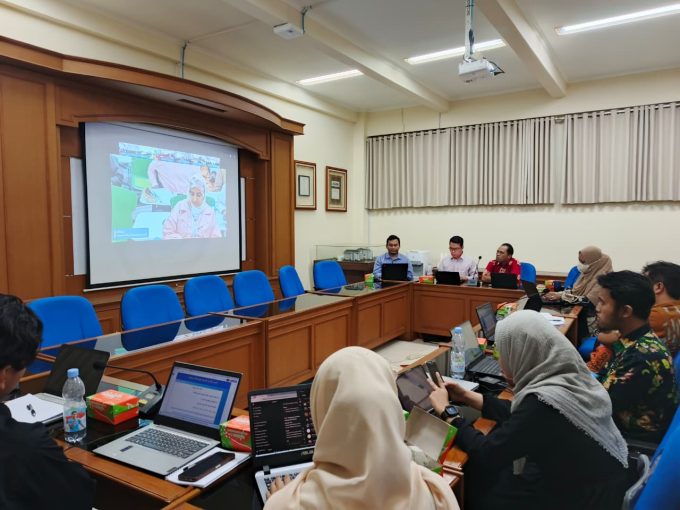
Yogyakarta, 13 November 2025 — The Arabic Study Program at Universitas Gadjah Mada (UGM), with Universitas Islam Negeri Sunan Kalijaga, Universitas Ahmad Dahlan, and Pondok Pesantren Muhammadiyyah, took part in the Arabic Language Teaching Training organized by the Islamic World Educational, Scientific and Cultural Organization (ICESCO). The training brought together not only participants from Indonesia but also representatives from various countries such as Malaysia, Thailand, Uzbekistan, Morocco, Russia, and others.
The ICESCO training focused on four fundamental theories in Arabic language teaching and learning. The first was the Grammar–Translation Theory, which is suitable for advanced learners and emphasizes reading, writing, and vocabulary mastery, particularly for academic, religious, and literary purposes. The second was the Behaviorism Theory (as-Sulukiyah), which views language as a form of behavior shaped through repetition and imitation, highlighting the significant role of environment in language acquisition. The third theory, Cognitivism (al-Ma‘rifiyyah), underscores that language learning involves active mental processes such as attention, information processing, and comprehension, placing learners as active participants rather than passive recipients. The final theory, Communicative Theory (at-Tawasuliyyah), emphasizes real-life language use within social contexts, prioritizing fluency and communicative ability over strict grammatical accuracy. This theory also acknowledges dialectal variations as an integral part of everyday language use.
In its concluding remarks, ICESCO highlighted that no single theory is entirely sufficient. Each has strengths and limitations, meaning effective Arabic language instruction requires an integrated approach that adapts to context. The training also emphasized the growing role of technology and artificial intelligence (AI) in designing lessons, generating exercises, and visualizing theoretical applications in more engaging and effective ways.
The Arabic Study Program at UGM’s participation in the ICESCO training reinforces the university’s commitment to strengthening the capacity of Arabic language educators and learners on campus. This initiative aligns with the Sustainable Development Goals (SDGs), particularly SDG 4 (Quality Education), SDG 16 (Peace, Justice, and Strong Institutions), and SDG 17 (Partnerships for the Goals). Through this involvement, the Arabic Study Program at UGM continues to advance as a progressive and globally connected center for Arabic language and cultural studies.
Author: Muhammad Ardiansyah
#UGMArabicStudyProgram
#FacultyofCulturalSciences
#UniversitasGadjahMada
#ICESCO
#SDGs4:QualityEducation
#SDGs16:Peace,Justice,andStrongInstitutions
#SDGs17:PartnershipsfortheGoals
