
- Home
- Berita (inggris)
Berita (inggris)

Want to Pursue a Career in the Creative Industry? Bentang Pustaka Yogyakarta Opens Job Vacancies!
Berita (inggris)Career Info Monday, 19 October 2026
- Website: www.bentangpustaka.com
- Instagram: @bentangpustaka
UGM Arabic Literature Students Strengthen Bonds Through Futsal Fun
Berita (inggris)IKMASA Tuesday, 13 October 2026
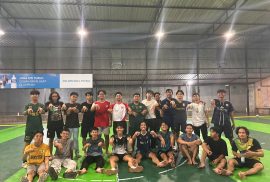
YOGYAKARTA — The Interest and Talent Department (MIKAT) of IKMASA UGM held a “Futsal Fun” event at Golden Goal Futsal, Pogung, on Friday, October 2, 2026. A total of 22 Arabic Literature students from various cohorts attended to enliven the event, which ran from 6:00 PM to 8:00 PM WIB.
This activity served as a platform for students to exercise while unwinding from their academic routines. The atmosphere on the court was casual and full of enthusiasm. Regardless of cohort differences or futsal skills, participants thoroughly enjoyed the game while sharing laughs and bonding together.
Beyond spending free time with positive activities, this event was also an opportunity to strengthen ties among students. Through playing together, students learned to build team cohesion and practice teamwork in a warm, family like atmosphere.
MIKAT IKMASA UGM hopes that activities like this can continue to be held regularly. Moving forward, Futsal Fun is expected to remain a simple yet effective way to maintain good relationships among students, broaden friendships across cohorts, and encourage active participation within the Arabic Literature study program at UGM.
Author: Sultan Amirul Muttaqin
#SDGs 3 Good Health and Well-being

Social Entrepreneurship: Building Independence Through Social Entrepreneurship
Berita (inggris)Student Activity Wednesday, 7 October 2026
YOGYAKARTA – An alumnus of Arabic Literature at Universitas Gadjah Mada, Ahmad Fauzi Qosim, S.S., M.A., delivered a Entrepreneurship lecture titled “Social Entrepreneurship Opportunities” attended by students of the Arabic Literature Study Program at Universitas Gadjah Mada. In the lecture, he explained that entrepreneurship is essentially not merely an economic activity aimed at pursuing financial profit, but rather a strategic path to build an independent, empowered society capable of solving various socio-economic issues sustainably. According to him, the philosophical meaning of the word wira signifies independence, which should serve as the primary foundation for every business actor so that the community does not remain continuously dependent on government assistance schemes.
To implement this philosophy, Ahmad Fauzi introduced the PROPHETIC – Socio-Technopreneurship concept, a business model that integrates business practice and social welfare based on the utilization of modern technology while upholding the values and business system exemplified by the Prophet Muhammad SAW. Through this approach, business activities are no longer focused solely on personal gain or worldly profit, but are also directed toward having spiritual value, blessings, and delivering a tangible positive social impact on the surrounding environment. This idea originated from Ahmad Fauzi’s personal concern upon completing his university studies, a post-graduation anxiety increasingly felt by many students today, given data showing that approximately 500,000 university graduates in Indonesia have not been absorbed into the workforce over the last five years.
The challenge of job availability becomes even more complex when confronted with the rate of global population growth and massive shifts in demographic structures. Citing the UN World Population Prospects report, the growing global population also triggers multidimensional crises across various sectors, ranging from food limitations, energy crises, healthcare service crises, and housing crises, to access to education and employment. In Indonesia, this condition is further exacerbated by a relatively high rate of urbanization, where statistical data shows a sharp increase in the urban population proportion from just 20% in 1980 to 53% in 2010, while the rural population declined from 80% to 47%. This demographic shift has had a significant impact on the emergence of various social and economic crises in both urban and rural areas.
The impact of these public economic problems has even reached remote areas, reflected in the proliferation of destructive habits such as online gambling and illegal online lending (pinjol). The prevalence of these phenomena indicates that public economic problems are not only triggered by a lack of daily income, but are also closely tied to low financial literacy and an inability to manage needs and make wise financial decisions. Therefore, the presence of professionally managed, transparent, and sustainable social enterprises serves as a strategic solution to empower communities through optimizing various funding instruments such as grant funds, waqf funds, and independent business profits thereby realizing long-term economic independence rather than merely offering instant fixes.
Author : Ahmad Ghifari
#SDGs 4 Quality Education
#SDGs 8 Decent Work and Economic Growth.