
- Home
- Berita (inggris)
- page. 8
Berita (inggris)

The Eighth Session of Entrepreneurship Class: Arabic Study Program Students at UGM Learn Sustainable Business Funding Strategies
AcademicBerita (inggris)Lecture Wednesday, 22 October 2025
The Eighth Session of Entrepreneurship Class: Arabic Study Program Students at UGM Learn Sustainable Business Funding Strategies
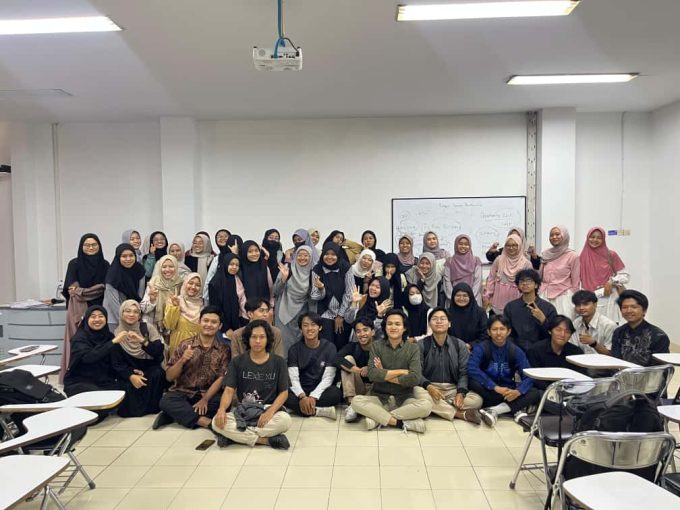
Yogyakarta, October 20, 2025 – The Arabic Study Program, Faculty of Cultural Sciences, Universitas Gadjah Mada, continued its eighth session of the Entrepreneurship course with lecturer Diyah Wikan Rakhmatika, S.S., M.A.. This session carried the theme “Business Funding Opportunities”, focusing on strategies to acquire, manage, and utilize financial resources effectively and ethically to support business sustainability.
In her presentation, Diyah explained that funding is a fundamental aspect of business continuity and growth. She emphasized that a successful entrepreneur is not only one who can generate creative ideas but also one who can manage finances wisely and determine the right funding strategy. Students were introduced to two main sources of business capital — internal funding (personal savings, reinvested profits, and support from family or friends) and external funding (banks, investors, venture capital, crowdfunding, Islamic financing, and government grants).
Furthermore, Diyah highlighted the importance of preparing a compelling and credible business proposal as a key to attracting investors. A well-crafted proposal, she noted, should clearly present the business vision, market potential, financial projections, and realistic return plans. She also underscored the principles of transparency, accountability, and Islamic ethics in financial management to ensure that businesses operate honestly, fairly, and sustainably.
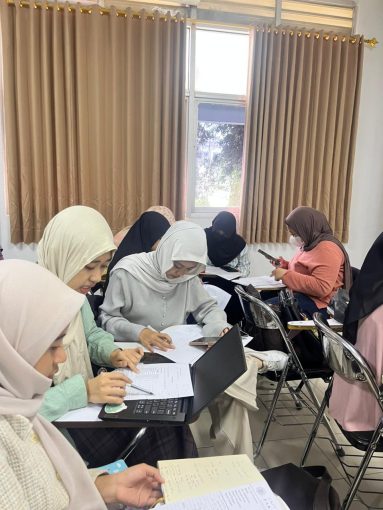
The session also explored real-world funding practices in Indonesia, such as the government’s Kredit Usaha Rakyat (KUR) program, venture capital schemes from institutions like East Ventures and Mandiri Capital Indonesia, as well as donation- and investment-based crowdfunding models. Through case studies, students were encouraged to identify opportunities and challenges in funding initiatives relevant to literature- and language-based entrepreneurship, including independent publishing, digital literacy content creation, and language learning platforms.
This session provided valuable insights for Arabic Study Program students to develop businesses that are not only intellectually creative but also financially robust. By understanding sustainable business funding strategies, students are expected to design independent, ethical, and impact-driven entrepreneurial models.
The course also supports the achievement of the Sustainable Development Goals (SDGs) — particularly SDG 4 (Quality Education) through practical entrepreneurship education, SDG 8 (Decent Work and Economic Growth) by fostering competitive young entrepreneurs, and SDG 9 (Industry, Innovation, and Infrastructure) by promoting innovation and sustainable resource management.
Author: Muhammad Ardiansyah
#SASTRAARAB
#SASTRAARABUGM
#FIBUGM
#SDGs4:QualityEducation
#SDGs8:DecentWorkandEconomicGrowth
#SDGs9:Industry,Innovation,andInfrastructure

The Seventh Entrepreneurship Class: Arabic Study Program Students Learn Financial Management in Business
AcademicBerita (inggris)Lecture Tuesday, 21 October 2025
The Seventh Entrepreneurship Class: Arabic Study Program Students Learn Financial Management in Business

Yogyakarta, October 13, 2025 – The Arabic Study Program, Faculty of Cultural Sciences, Universitas Gadjah Mada, continued its Entrepreneurship course series with the seventh session featuring a new speaker, Diyah Wikan Rakhmatika, S.S., M.A.—an academic and business practitioner with extensive experience in Islamic economics and financial management. In this session, Arabic Study Program students explored the crucial topic of Financial Management in Entrepreneurship.
During the lecture, Diyah emphasized that financial management is the backbone of business sustainability, where maintaining a balance between income and expenditure must be grounded in transparency and accountability. She highlighted that many entrepreneurs, especially in the UMKM sector, struggle to grow because they mix personal and business finances. Therefore, students were encouraged to understand the importance of financial separation, regular transaction recording, proper budgeting, and periodic financial evaluations to assess business performance effectively.
The lecture also covered three essential financial reports that every aspiring entrepreneur should master: the income statement, cash flow statement, and simple balance sheet. These reports serve as critical tools for measuring profitability, maintaining positive cash flow, and understanding the overall financial health of a business. Diyah further introduced the concepts of cash flow management and reinvestment strategy as strategic approaches to maintaining financial stability and supporting long-term business growth.

Beyond the technical aspects, Diyah also discussed the ethical and social responsibilities of financial management. She linked sound financial practices with the principles of sustainability, emphasizing that business profits should not solely benefit the owner but also contribute to the well-being of employees, communities, and the environment—such as through corporate social responsibility (CSR) initiatives.
Through this seventh session, students of the Arabic Study Program at UGM were expected not only to understand financial management theory but also to apply it in their ongoing business plan projects. With strong financial literacy, students can build ventures that are not only profitable but also ethical and sustainable.
This entrepreneurship class also aligns with the United Nations’ Sustainable Development Goals (SDGs), particularly SDG 4 (Quality Education) by providing practical entrepreneurship education, SDG 8 (Decent Work and Economic Growth) by fostering competent young entrepreneurs, and SDG 12 (Responsible Consumption and Production) by instilling values of efficient and ethical resource management.
Author: Muhammad Ardiansyah
#SASTRAARAB
#SASTRAARABUGM
#FIBUGM
#SDGs4:QualityEducation
#SDGs8:DecentWorkandEconomicGrowth
#SDGs12:ResponsibleConsumptionandProduction
MODERN LANGUAGE OLYMPIAD (MLO) 3.0 COMPETITION IS OPEN! REGISTER YOURSELF NOW!
Berita (inggris)CompetitionInternational Friday, 17 October 2025
MODERN LANGUAGE OLYMPIAD (MLO) 3.0 COMPETITION IS OPEN! REGISTER YOURSELF NOW!
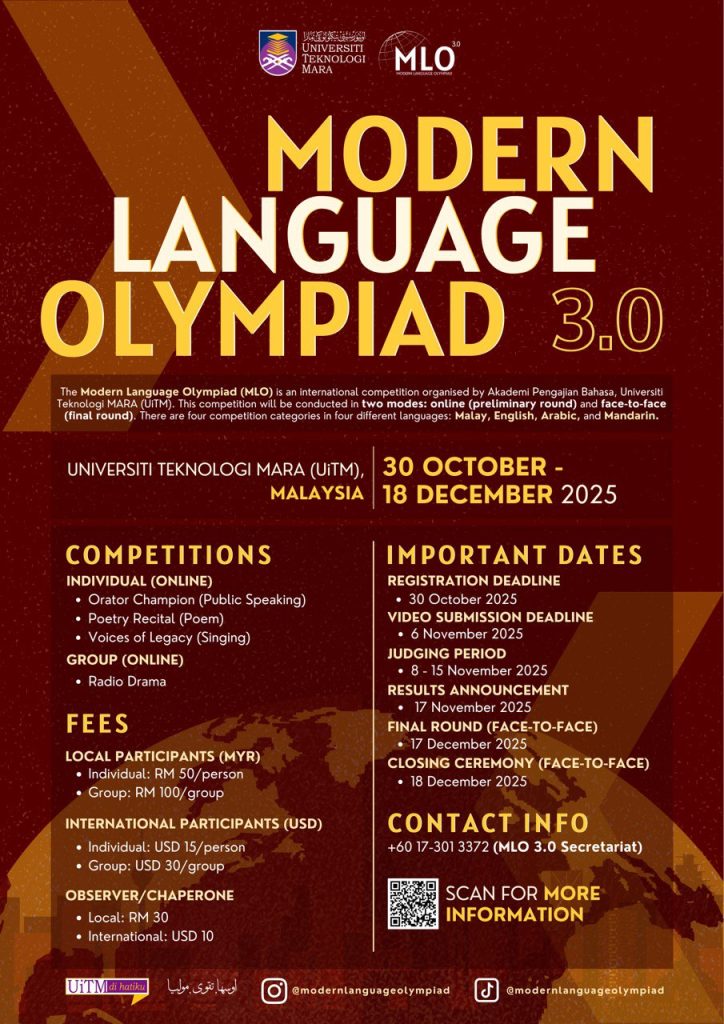
The Modern Language Olympiad 3.0 (MLO 3.0), is an international program organised by Universiti Teknologi MARA (UiTM), Malaysia. Modern Language Olympiad 3.0 (MLO 3.0) features four(4) categories in four(4) languages – Malay, English, Arabic and Mandarin.
This year, Modern Language Olympiad (MLO) 3.0 embraces the spirit of global collaboration through two exciting competition stages. The first stage is the online preliminary round, where participants will submit their performance videos digitally. The second stage is the face-to-face final round, which will be held directly at Universiti Teknologi MARA (UiTM), Malaysia, on 17–18 December 2025.
COMPETITIONS:
- Poetry Recital
- Champion Orator
- Drama Radio
- Voices of Legacy
MLO 3.0 TIMELINE:
-
Participant Registration: 30 October 2025
-
Video Submission (Preliminary Round): Until 6 November 2025
-
Judging Period: 8–15 November 2025
-
Announcement of Preliminary Results: 17 November 2025
-
Final Round (Face-to-Face): 17 December 2025
-
Closing Ceremony: 18 December 2025
📌 Please ensure that you have thoroughly read and understood the terms and conditions of participation prior to submitting your registration.
Furhter Information:
Contact Person (WhatsApp): https://wa.me/60173013372
Email: modernlanguageolympiad.uitm@gmail.com
Website MLO 3.0: http://modernlanguageolym.wixsite.com/website